Monday, September 14, 2015

Bolterdalen and Foxvanna

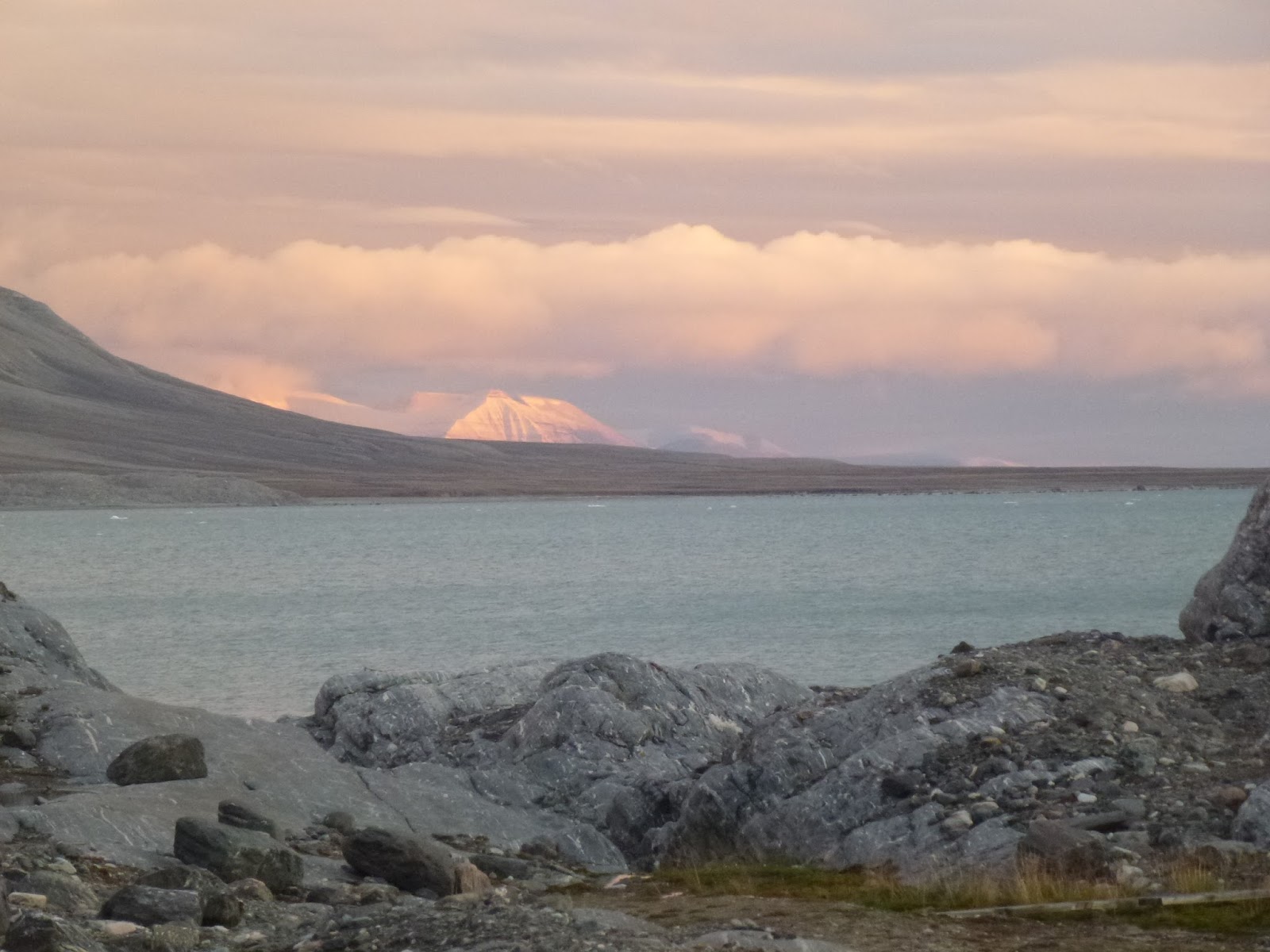
Our last two days of field work for Quaternary Geology of Svalbard took us to Bolterdalen and Foxvanna for two day-trips. The area is about a fifteen minute drive outside of Longyearbyen along a dirt road that leads through the main fjord of Adventdalen. Vacation cabins dot the brownish-green valley-sides which rise to snow-covered  mountains. Well snow-cover is not really an indicator of high elevation here in the Arctic. I forgot to mention in my last blogpost that while we were away in Nordenskioldbreen, it snowed for the first time this season. It didn't stick in Longyearbyen, but there was enough of an elevation difference to Nybyen (where our dorm buildings are, 3km uphill) that there was snow on the ground. Here in Bolterdalen too there was snow.

A map of Adventdalen, with Longyearbyen in the center and Bolterdalen/Foxvanna in the lower right corner.


A view across Adventdalen

The class was split in two, and my group was tasked with climbing up the mountain to get to Foxvanna Glacier to map it using ArcGIS software on our Toughbooks (really cool laptop/tablets that are extremely durable and waterproof). Walking to the mountain from our bus drop off point was interesting, we stopped every couple meters to take note of some minor change in the topography. The ground was very bouncy from the thick moss cover.

Starting our walk up 


We arrived at the base of the mountain. It was a very steep slope covered in loose slate and other rocks. Climbing it took nearly all your concentration as you picked out spots where you could put your foot without sliding down. Due to frost-processes in the dirt, there were many rocks that jutted out like spikes, sunken into the dirt on their thin side. I was out of breath very quickly and others in my group were even slower. People who had a fear of heights had a tough time.  


Just as I thought I had reached the top, there was another slope, this time covered in loose stones and snow. The snow actually helped give traction and you could always tell that where there was snow there was a small foothold. We weren't alone on the mountain. Off to the north were a herd of reindeer and right in front of us was a small flock of rock ptarmigans, also known as snow chickens. They are pretty easy to see when they're moving around, but I realize now they are almost impossible to see in a photograph, that's how good their camouflage is.


Can you see the three snow chickens in the picture?

Do you see them?

How about here?

Finally we made it to the plateau at the top of the mountain. It was a snow covered expanse of little tussocks of grass and rocks.  We were told to walk on the tops of the exposed rocks and not on the snow where the depth was invisible.


We ate lunch on top of a small moraine, looking down into the valley and Foxvanna glacier below.  Foxvanna means fox head, and from the air, the glacier does seem to have little fox ears separated by a large mound in the center. We then split in two again, our group would map in detail the slope immediately below us and the other group would travel to the other slope. Our leader was an American PhD student named Wesley who was a very chilled out, snowboard-bum type (but I must add incredibly smart and knowledgeable about our location).

One of our teachers, Lena Rubensdottir 

One "ear" of Foxvanna Glacier

The view across the fjord valley

Going down the slope was nearly as hard as going up, and it was very easy to slip on the loose rocks covered in snow. Every couple meters, we took note of some detail of the rocks - a change in color or size, any kind of structure like a flute or mound.


We got to the glacier ice and were not allowed to walk on it, as meltwater channels could be lightly bridged with snow and we could twist an ankle (not nearly as dangerous as a crevasse - Foxvanna is not that kind of glacier). 


Even if we couldn't see the meltwater, we could hear it. We were walking along the edge of the glacier, where the surface was little different than the surface we were on before. But every so often, we'd hear the rush and babbling of a strong meltwater channel right below us. 

Past the edge of the glacier, were enormous, truck-sized boulders. The one pictured below was easily the size of a pick-up truck.


The tesseract from Thor

Taking notes on the rocks

Looking up the slope we had just descended. The pointy bits are called cornices. We didn't go down those, obviously. 
 Beyond the large rocks was a large frozen pond or river. Wesley explained to us that the chemistry of this ice was different than the glacial ice, and that no one quite knew how it formed. 'Is it frozen glacial meltwater?' I asked. 'Maybe' he responded. 'What do you think it is?' I asked. 'I'm not here to tell you all the answers.'  Uh, ok. We spent a good twenty minutes just sliding around on the ice, kicking it. It was around 3:20 when I asked if we were waiting. 'No, but we should head out soon to return to the bus.' We went back to just standing around and looking at the ice. We got a good look underneath.

Underneath the frozen lake or whatever it is.


By then it was 3:30pm. I asked Wesley what time we were supposed to get back to the bus. '4:15' Uuuuh. I stand by my characterization of him as a snowboard-dude. We climbed back up to the plateau as fast as we could. At this point I didn't really care about snow, so I just walked straight through knee-high snow drifts high up on the mountain. The five of us in the group were getting more and more spread out as the faster walkers moved ahead, Wesley already pretty far in the distance with the rifle. I was annoyed since this was exactly what you weren't supposed to do. I waited to walk with the slowest walker, Sara. I don't care about being late if it means being not being safe from being picked off one by one by a bear. Climbing down the slope back to the bus was...interesting. The best strategy I found was to pretend like I was skiing.  I made tight S-curves by walking back and forth and sliding carefully with each step. We got back to the bus at 4:55pm. The teacher had an annoyed look on her face as I rushed onto the bus. 


The next day, the last day of fieldwork was mostly anti-climactic. I forgot my phone and camera, so I don't have any pictures. Our work that day was large-scale mapping of Bolterdalen. We walked up Bolterdalen, over little spongey tussocks of grass and saw meltwater channels, frost heave mounds, debris flows, braided rivers, and a small glacier. But our leader, Sarah, an Alaskan working in the Logistics department of UNIS, was not very enthusiastic. We walked, had lunch, walked a little further, met up with the other group, and then walked back. It was fairly restful with no excitements. 


A very shaky picture of the interior of Kroa

To celebrate our last day of fieldwork, the whole class went to Kroa, one of the nicest restaurants in Longyearbyen. They had smoked Minke whale on the menu and seal pelts everywhere as decor (seal pelts are really everywhere). The menu was very strange: it had two fancy dishes, one including the whale, and pizza, all with pineapple on it. The waiter said we could also have hamburgers.  I had a hamburger, it was rubbery.  

Saturday, September 12, 2015

Pyramiden

On our way back from field work, we took a quick stop to visit Pyramiden, a Russian coal-mining town, abandoned due to being too unprofitable in the distant time of 1998. We were led by a tour guide named Sasha who had a big beard, a rifle, and a stereotypical Russian wool coat and hat. He is one of six people living in the town now to service tourists. They get their food and supplies from Barentsburg by helicopter, can only send letters for communication (though there is a 1 meter square spot near the docks where a faint Telenor signal can be found). The town is tidy and very Soviet utilitarian. It's not that spooky.


Pyramiden was originally a Swedish mining town until the USSR bought it from them in the 1920's. After some initial coal prospecting, the USSR planned to open a mining operation in the 1930's, built some buildings in the 30s and 40s, but were unfortunately delayed by WW2. They didn't start mining again until the mid-50's. The heydey of Pyramiden was the 1970's when there were over 1400 inhabitants, including families, a multi-doctor hospital, and a large athletics hall. 

Below the sign in the ceremonial "Last wagon of coal." Tourists kept taking the coal, so now it's filled with black-painted rocks


For an ugly town, it has an incredible view


Written on the mountain is the phrase "Mira Mir" or Peace on Earth

This is the Pyramiden farm building where a milk-cow, chickens and some vegetables were raised during the town's active period. 

The red window in the picture below is where in 2001, a polar bear broke into the functioning hotel, wandered over to the bar and ate all the beer nuts and drank all the beer. It then wandered out. The people of Pyramiden are very proud of the fact that they did not shoot the bear, even though they had the legal right to.


Me with the Northeernmost Lenin statue in the world
For those of you who haven't heard me blather about it, there is a bust of Lenin here in Pyramiden, the northernmost bust of Lenin, and there is also one at the Antarctic Pole of Inaccessibility, the point in Antarctica that is furthest from the ocean. I was so excited to be able to see the northernmost, and maybe, just maybe, I will one day visit the southernmost bust of Lenin as well.


Inside the athletics center


At the end of the tour, we went into the hotel for, I guess, souvenirs and refreshments. But the only souvenirs were weird expensive Pyramiden collectors coins, and the refreshment counter didn't really have anything. The thing to do, apparently, was to buy shots of vodka. But we were on a school trip and would get in trouble for drinking. The hotel was run-down and pretty sad. The only thing I could think of was how weird the six people who live here must be. What kind of person signs up to live in Pyramiden? All you can do is guide people around the decaying town all day, or maybe drive the bus or service the hotel. Do they take turns with each job? Are there married couples? Or maybe all six are in a large polyamorous relationship together. In any case, we were soon back on the boat, tiredly eating chocolate, waiting to return.

Once we got back to Longyearbyen at 9pm, we then had to unload the ship and were bussed back to the UNIS school building.  For about an hour, we then needed to go through all of our bags, clean the tents, return everything, etc. Which was all fine to do, but all of us were just completely exhausted and wanted to just go home. Finally at 10:30pm, we were driven back in groups to Nybyen, our dorms. I was with the last group, so I didn't get home until 11pm. I immediately changed clothes took a shower and tried to decompress from five days in the field. I had over a hundred emails, and it turns out that I needed to proofread my entire campus literary magazine by 3am. Ugh. So I did.  Went to sleep at 2:30am after being awake since 4:50am the previous day. I was very glad to be back sleeping in a bed. 

Next: Two days of fieldwork at Bolterdalen

Thursday, September 10, 2015

Nordenskioldbreen - Days 2-5


The second day of my field work was the bad weather day. It started with a light snow that got heavier and heavier. The work that we had was fairly simple: walking around with a waterproof, coldproof, shockproof laptop/tablet called a Toughbook (they're really cool) mapping glacial flutes with GPS data. Glacial flutes are long, half-cylindrical trails of sediment that form behind large boulders in the direction of glacial flow, like a glacial shadow where the boulder creates a vacuum, and the "shadow" is filled with the glacial till. In any case, it became increasingly difficult to see the flutes as the snow accumulated on the ground. Eventually it was time for lunch. We all had DryTech meals - orange bags of dehydrated food that you just needed to add hot water to. This day I had beef stew, to which I added one of my dried fruit balls which made it taste pretty good. Honestly, after walking around in the snow, a warm meal was greatly appreciated.


About halfway through eating lunch the snow turned to rain. The snow was melting all around me and the water was making its way through my layers of clothes. Being wet and cold all afternoon was no fun. My group was taking geological notes about a large hole that the previous group had dug. At about 3pm, I made myself a garbage-bag poncho by punching some holes in a big black garbage bag. Also, my rabbit fur hat was completely drenched, looking like a dead wet animal. Finally at 5pm, the rain had stopped, but I was very wet. We were able to go home to our warm cabin and eat snacks. We also got to put our wet things in a drying room. I put in my hat (which took two days to dry), and all three pairs of gloves that I brought.


By the time we left for the day, all the snow had been melted away by the rain

My poor field notebook drying.

For dinner we had tomatoey fish stew with hard chunks of fish. That night, the wind was really loud, and climbing out of my tent for my 1am-2am polar bear guard shift especially frustrating.


The next day was dry and beautiful, if a bit windy. 


I had a Pasta de Provence DryTech lunch, and beef stew for dinner. My polar bear watch was 2am-3am, and it was very very windy. But the dog had been removed (someone rightly complained that the dog was more of a nuisance than a help).


The last day of field work, and the second to last day of camping,  we went out  a little further on the outwash plain, taking notes on an area outside where we spent the last two days. Then we dug a geology hole, about a meter deep into the cold, rocky sediment of a megaflute.


For lunch, I had another pasta DryTech, and as you can see below, we all huddled together in a small depression in the ground for windcover.


The afternoon was spent taking clast fabric measurements, i.e, finding rectangular rocks and measuring their orientation and dipping angle for two and a half hours. 


some bird bones I found


Field geology involves a lot of wandering around with a notebook

Having finished with my geological observations, I took pictures of tiny plants

More tiny plants


Mapping dead-ice hollows (where subsurface glacial ice melted away, making a little depression).

For dinner, we had chicken korma and rice After dinner, we may have jumped into the Arctic Ocean. It may have been very cold. But there's no photographic evidence, so know one will ever know.  After changing out of wet clothes, some of us went to walk up closer to the glacier. 


The sun set behind us a bit as we walked up. 


Nordenskioldbreen glacier close up


Some selfies

With the fieldwork done, we only had some geological wrapping up and packing up to do the next morning. Of course, this last night I had the worst polar bear guard shift: 5-6am. And the wind was blowing so hard that the tent walls were whipping back and forth loudly. I was ready to go home and have real amenities again.